
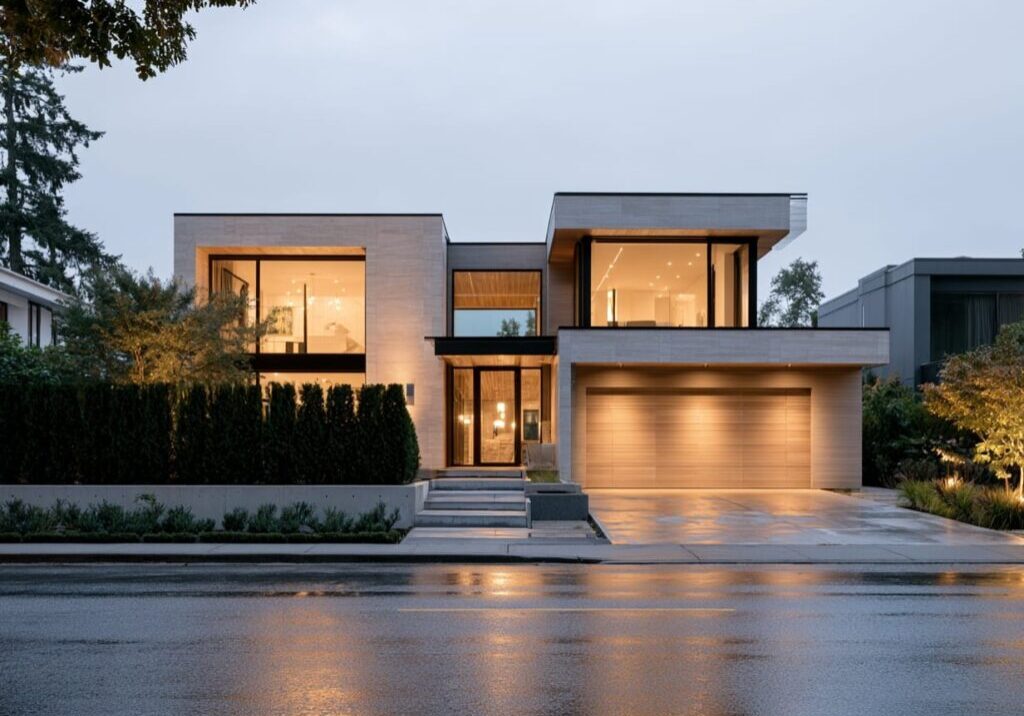
If you are planning a custom home in Greater Vancouver, here is a question most people never think to ask: what will the public be able to learn about your project? The honest answer is more than you would expect. Your street address, the declared value of the project, the type of work, and the names and mailing addresses of the applicant and the building contractor are all published. Finding out who owns the property costs anyone about $15. Your drawings, at least in Vancouver, stay with you. Knowing where those lines sit before you file anything is the difference between managing your privacy and being surprised by it, and it is where the work of a discreet custom home builder actually begins.
One myth is worth clearing up right away, because it comes up in almost every first conversation. If someone told you that buying through a numbered company keeps your name out of the public record in B.C., that has not been true since 2020. It moves your name to a different register. It does not remove it.
The good news is that the most personal part of your file, the plans themselves, has real protection in some cities. Much of the rest is easier to find than most homeowners realize. Here is how it actually works.
What Actually Goes Into the Public Permit Record in B.C.

You do not need to imagine a determined investigator digging through city hall. A meaningful part of your permit file is published automatically, as open data anyone can download without a request, a fee, or a reason.
What Vancouver Publishes About Every Permit
Vancouver releases a public dataset of every building permit it issues. Each record includes the permit number, when it was applied for and issued, the declared project value, the type of work, the property address, a description of the project, the applicant’s name and mailing address, and the building contractor’s name and mailing address, along with map coordinates. In plain terms, two named people or companies, each with an address, sit in a file anyone can open in a spreadsheet.
The project value deserves special attention. It is a declared construction value, not your budget and not a purchase price, but it is specific enough that a neighbour or a curious stranger can get a good sense of the scale of what you are building from a free download, before the excavator ever arrives.
How Fast It Goes Public
Quickly, and permanently. The dataset covers permits issued from 2017 onward and is updated daily, so a permit issued this month appears in the public file within days, and past years stay available. It already holds more than 51,000 records and grows every day, and nothing is ever retired out of it. Vancouver is not alone, either: Burnaby, for example, publishes lists of the permits its building division issues each month.
What the Dataset Leaves Out
There is no owner name field in Vancouver’s dataset. The named parties are the applicant and the contractor, so if your architect applies on your behalf, the dataset alone does not say who owns the house.
Do not let that reassure you too much. Ownership is not hidden in B.C. It simply lives in a different register, and looking it up costs about as much as lunch. That pattern repeats throughout this topic: whenever something looks private, the right question is which other public record holds the same fact under a different name.
Who Owns the House: Title Searches, the Transparency Registry, and Numbered Companies

This is the area where homeowners are most often given outdated advice, so the correction comes before the detail: since 2020, holding B.C. property through a company or a trust changes which register your name appears in, not whether it appears.
What a Title Search Shows and What It Costs
A title search returns the registered owners, the legal description of the property, and any mortgages, liens, or other charges registered against it. It does not include phone numbers or the history of past owners. Anyone can run one through the Land Title and Survey Authority for about $14.61 all in: an $11.06 search fee plus a $3.55 transaction fee, with fees adjusting each April. No reason is required, and you are never notified that someone looked.
The search needs the property’s parcel identifier rather than just a street address, but that number is easy to find through free public mapping and assessment tools. Treat it as a five minute detour, not a barrier.
Why a Numbered Company Does Not Hide You
Since 2020, any company, partnership, or trust that holds B.C. land has been required to disclose the actual people behind it, and those names go into the Land Owner Transparency Registry, which is publicly searchable. That includes bare trusts. So a numbered company moves your name from the title register into the transparency registry. It does not take it off the public record. Anyone telling you otherwise today is working from a pre-2020 picture.
Anyone Can Search the Registry, and It Is Free
Searches work in both directions: someone can start with your name and find the property, or start with the property and find the names behind it. A search returns the name of the company or trust, the people behind it, their city of residence, and the type of interest they hold. It requires a basic account, and searching has been free since April 2024. Set the two registers side by side and the picture is uncomfortable but clear: the paid one hides less than people assume, and the free one hides less still.
The 90-Day Window Is a Delay, Not a Shield
When a new transparency filing is made, certain personal details are held back from public view for at least 90 days. That sounds protective, but it is a clock, not a wall. Once the 90 days pass, the information becomes publicly searchable by default. On a typical build, that window has often closed before framing is finished, so treat it as timing, never as protection.
The Narrow Exceptions
Only two situations keep a person’s details out of the registry. Minors and people legally incapable of managing their own affairs are omitted automatically. Anyone else must apply and show that public access could reasonably be expected to threaten their safety or health, or that of someone in their household. Separately, and in every case, your date of birth, social insurance number, and home address are kept out of public view. That is real protection, but a narrow one: it shields your identifiers, not your name. If you think an exception might apply to you, that is a conversation for a B.C. lawyer.
The BC Assessment Gap: The Free Search Versus the Paid One
Here is a case where a technically true statement can leave you with the wrong impression, because both halves of it are true at the same time.
The Free Public Search Does Not Name You
The free BC Assessment search, the one most people use to look up a property, does not display owner names. It shows the address, the legal description, and the assessment and building details, but your name is not in it. BC Assessment even blurs licence plates and faces in the photos it publishes.
A Paid Government Tool Searches the Same Data by Name
Now the other half. A paid government service reaches the same assessment data from the opposite direction, letting subscribers search by owner surname, first name, or company name, across the whole province, partial names included. So not appearing in the free search is not the same as being private. Anyone who tells you the first half without the second is leaving you with a false sense of security.
What’s Protected, What’s for Sale, and Who Decides

Two things are true here, and they are true in different cities. Your plan set has real protection where a city has a rule saying so, and in another city a stranger with a credit card can still buy a surprisingly detailed picture of your house. These rules are set city by city, and no single city speaks for all of B.C.
Vancouver Releases Building Plans Only to Owners
In Vancouver, only the current registered owners of a property can access and copy the plans for their building, and owners can authorize a representative to do it for them. A third party needs your written authorization. Retrieval starts at a minimum of $62 plus $17.10 per archived image, and the City holds plans for most homes built since 1979. That protection matters more than it might sound, because what a Vancouver permit drawing set has to include is more revealing about how you live than most owners expect: room layouts, ceiling heights, glazing, and the relationship between your private and entertaining spaces.
Surrey Sells Building Records to Anyone for $28
Surrey runs an online building records search with a credit card checkout and no owner authorization step. For $28 each including GST, anyone can buy a copy of your building permits with the issuance date, the final occupancy date, the inspection notes, the square footage, and any oil or septic tank information. A survey certificate showing the building’s footprint on the lot is free by email request, and turnaround is about one business day.
That is not your plan set, but it is not nothing either. Square footage, occupancy date, inspection history, and a footprint drawing add up to a substantial portrait of a house, assembled by a stranger in a day for the price of a decent dinner. Surrey handles actual building plans through a separate request process, so ask before you assume.
Every City Sets Its Own Rules, So Ask Yours
Access rules are decided city by city rather than province-wide, and as Vancouver and Surrey show, two neighbouring cities can land in very different places. The practical move is simple and unglamorous: before you file anything, ask your municipality in writing what building records it releases, to whom, and at what price. Do it at the start of the project, because the answer may change how you sequence the application and who is named on it.
If Someone Requests Your File Anyway

Beyond the open data and the paid searches, a determined person can file a formal freedom of information request with the city. That process is less dramatic than people fear, and one part of it genuinely works in your favour.
When the City Can Say No
Cities can refuse to release business and financial information that was supplied in confidence where releasing it would cause real harm, and personal financial details carry a strong presumption of privacy. Permit-level facts, on the other hand, are generally treated as releasable, because a permit is a public benefit granted by the city. That is the pattern behind everything in this article: the basic facts of your permit are usually obtainable, while your detailed cost breakdown is the strongest thing to protect. Every request is decided on its own facts, so be sceptical of anyone promising a guaranteed outcome in either direction. That assessment belongs with a B.C. lawyer.
What Copyright Does and Does Not Do
A common misconception is that your architect’s copyright keeps your drawings private. It does not. Copyright does not stop a city from releasing records under access legislation. What it does is stop the person who receives them from reproducing the drawings or building from them. In other words, copyright protects the design, not your privacy.
What’s Public, What Isn’t, and What It Costs to Find Out
Most people assume privacy is a question of what is legally sealed. Cost tells the truer story: every route below is under $65, most are under $30, and two are free. The barrier is not money. The practical question is not whether someone could find out, but whether they would bother to look.
| Record or registry | What’s public | What isn’t | What it costs to look |
| Vancouver open permit data | Address, project value, type of work, applicant and contractor names and mailing addresses | Owner name is not a field in the dataset | Free |
| Land title register | Registered owners, legal description, charges and liens | Phone numbers, past owner history | About $14.61 all in |
| Land Owner Transparency Registry | Names behind companies and trusts, city of residence, type of interest | Date of birth, social insurance number and home address; new filings held back for at least 90 days | Free since April 2024 |
| BC Assessment free public search | Address, legal description, assessment and building details | Owner names | Free |
| BC Assessment via the paid government service | Province-wide search by owner or company name | No published limits we can point you to | Paid subscription |
| City of Surrey building records search | Permits, occupancy date, inspection notes, square footage, oil or septic details; free survey certificate showing the footprint | The plan set, which goes through a separate request process | $28 each including GST |
| City of Vancouver building plan archive | Plans, released only to current registered owners or someone they authorize | Third-party access without your authorization | $62 minimum plus $17.10 per archived image |
| Municipal freedom of information request | Records not already routinely released | Confidential business information and personal financial details | Small fees; Delta charges $10 plus copying |
Fees change over time, so confirm current figures with each office before relying on them.
What Goes Up on the Street During Construction
Some disclosure is physical rather than digital. It happens at your property line, and two very different things get posted there. They are frequently confused with each other.
The Permit Card on Site
Burnaby, for example, requires the building permit to stay posted in plain view on site for the duration of the work. That is mandatory, it is visible from the sidewalk, and no arrangement with your builder changes it. Posting rules vary by city, so if you are building elsewhere in Greater Vancouver, assume a card will be visible and confirm the specifics with your municipality rather than expecting your site to be anonymous behind hoarding.
Development Application Signs Are a Different Thing
A development application sign is not a permit card, and it only appears when a project needs a rezoning, a development permit, or a variance, which most straightforward custom home builds never do. Where one is required, it is a much larger disclosure. Coquitlam’s version is a sign 2.4 m (8 ft) wide by 1.2 m (4 ft) high carrying the address, a description of the project, and the applicant’s name, phone number, and email, and it stays up until the application is decided. If your project might trigger one, you want to know before you apply, not after the sign goes up.
How Someone Requests Your Permit File, and What Happens Next

Knowing what a request looks like from the inside helps you judge how exposed you really are, and one step in the process is worth more to you than everything else combined.
Much of It Never Needs a Request at All
Cities keep routine release lists: categories of records they hand over without any formal process. Zoning information, business licences, and development applications are typical examples. Nobody files paperwork for those, and you are not notified when someone asks.
The Request, the Clock, and the Cost
For anything else, the requester puts it in writing and the city generally has about 30 days to respond. Fees are modest. Delta, for example, charges a $10 application fee, gives the first 3 hours of search time free, and then bills $7.50 per quarter hour plus $0.25 per page for copying. In other words, neither time nor money is a real barrier to a motivated requester. Timelines and fees vary by city, so take the specifics from your own municipality in writing.
You Get Notified, and You Can Object
Here is the part that genuinely works in your favour. If a city is considering releasing records that concern you, it must notify you in writing, describe what has been asked for, and give you 20 days to consent or to argue against release. You are unlikely to find out after the fact that your file went out the door. One honest caveat: where records reveal a risk of significant harm to public health or safety, the city must release that information regardless of objections, and no builder or lawyer can promise you otherwise.
What You Can Actually Control
The registries are fixed. Everything else is not, and it deserves the same concrete attention, because privacy on a high-profile build is mostly won or lost here. None of what follows is a way around public disclosure, and we would not offer one. It is contract and site practice.
Site Conduct, Photography, and Trade Confidentiality
In our experience, the leak on a high-profile build is a person, not a register. A register releases a project value; a phone releases a floor plan, a name, and a date. The fix is contractual and deliberately boring, which is exactly why it works: trade and subcontractor NDAs signed before anyone mobilizes are far easier to enforce than a conversation held after a photo appears somewhere.
Alongside the paperwork, we keep site rules simple and decided in advance: no photography without written approval, no site address in supplier paperwork beyond what invoicing requires, deliveries scheduled rather than open-ended, and a single point of contact for anyone asking questions at the fence. None of it is exotic. It is just decided early instead of improvised in month four.
Before You Buy the Lot
Ownership visibility is set when you buy, not when you apply for a permit. By the time an application is filed, the title and registry picture is already what it is, which makes the lot stage the most important privacy decision of the whole project. It also shapes the search itself, since discreet lots actually change hands through pocket listings and private broker channels, a very different process from a public listing with a visible history.
One sequencing point belongs in the same conversation. The applicant and contractor names on a permit are published and permanent, so decide who will be named before the application goes in. That does not reduce what the record shows. It saves you from finding out what the record shows after it is already showing it.
Where You Need a Lawyer, Not a Builder

There is a clear line in this topic, and we would rather draw it than blur it. How you hold title, your obligations under the transparency rules, an application to keep your details out of the registry, and any argument over a specific records request are legal questions, decided on their own facts by people qualified to decide them. We can tell you what the registries publish, how permits work in the cities where we build, and what your file will look like at each stage. We cannot advise on ownership structure, and any builder who offers to is out of their depth. Bring a B.C. lawyer in before the lot closes, because most of what can be decided is decided early.
Building Privately in Greater Vancouver, With Realistic Expectations
Privacy on a custom home is won in the places the public record does not reach: the contract, the trade roster, the site, and the schedule. Our schedules are detailed and our trades are pre-booked, which means fewer unfamiliar people cycling through your site and fewer improvised arrangements nobody vetted. Our client portal carries daily logs and progress photos, so you can follow the build closely without site visits that draw attention on a quiet street. Versa Homes works on fixed-price contracts, so the cost detail lives in one document rather than a trail of change orders.
If that is the way you want to build, the work of a private custom home builder is mostly the unglamorous discipline of deciding things early, and we would rather walk you through what your file will actually look like than let you discover it later. When you are ready, start a confidential conversation with our team and we will map out what is public, what is not, and what it changes about your plan.
Frequently Asked Questions
Is My Name on My Building Permit in B.C.?
In Vancouver, the published permit record names the applicant and the building contractor, not the owner, so your name appears only if you apply in your own name. Other cities publish differently, so confirm what your own city releases rather than assuming Vancouver’s approach applies everywhere.
Can Anyone Find Out Who Owns My House in B.C.?
Yes. A title search returns the registered owners for about $14.61 all in, and where a company or trust holds title, the Land Owner Transparency Registry is searchable by name or by property free of charge. Neither search requires a reason, and neither notifies you.
Does a Numbered Company Keep My Name Off the Public Record?
No. Since 2020, companies and trusts that hold B.C. land must disclose the people behind them, and those names are publicly searchable in the transparency registry, bare trusts included. The structure moves your name between registers rather than removing it, and anything structural is a question for a B.C. lawyer.
Can a Stranger Get Copies of My House Plans?
In Vancouver, no: plans are released only to current registered owners or someone they authorize in writing. Plans are not the whole file, though. In Surrey, anyone can buy your permits, occupancy date, inspection notes, and square footage for $28 including GST with no authorization step, and every city sets its own rules.
Does BC Assessment Show My Name?
Not in the free public search, which shows the address, legal description, and assessment details without owner names. A paid government service does let subscribers search the same data by owner or company name province-wide, so the free search not naming you is not the same as your name being unavailable.
Will a Sign With My Name Go Up in Front of My Property?
The building permit itself must be posted on site in cities like Burnaby for the duration of the work, but it is a card, not a billboard. A large development application sign carrying the applicant’s name, phone number, and email only applies where a rezoning, development permit, or variance is involved, which most custom home builds never trigger.


Felipe Freig
Founder of Versa Homes
Felipe Freig is the founder of Versa Homes, a Vancouver custom home builder known for architecturally driven, fixed-price projects. With years of hands-on site experience and deep permitting and by-law knowledge, Felipe leads high-performance teams that deliver precision craftsmanship, clear budgets, and on-schedule luxury homes.
You May Also Like...

Burnaby Zoning Rules That Shape Custom Home Design


Green Living with Versa Homes: Integrating Sustainable Practices into Your Custom Home Design

How To Verify Builder Insurance And Warranty Coverage In BC


From Raw Lot To Building Permit: The 9-Month Story Most Buyers Don’t See

Permit Costs in B.C.: What You’ll Really Pay (and Why It Matters)

Rainscreen Requirements For Coastal BC Homes: What To Plan For